Word Search Hunt
- 4.9
- Rating
- 500.00K
- Installs
- Free
- Price
 Analysis by App-foxy
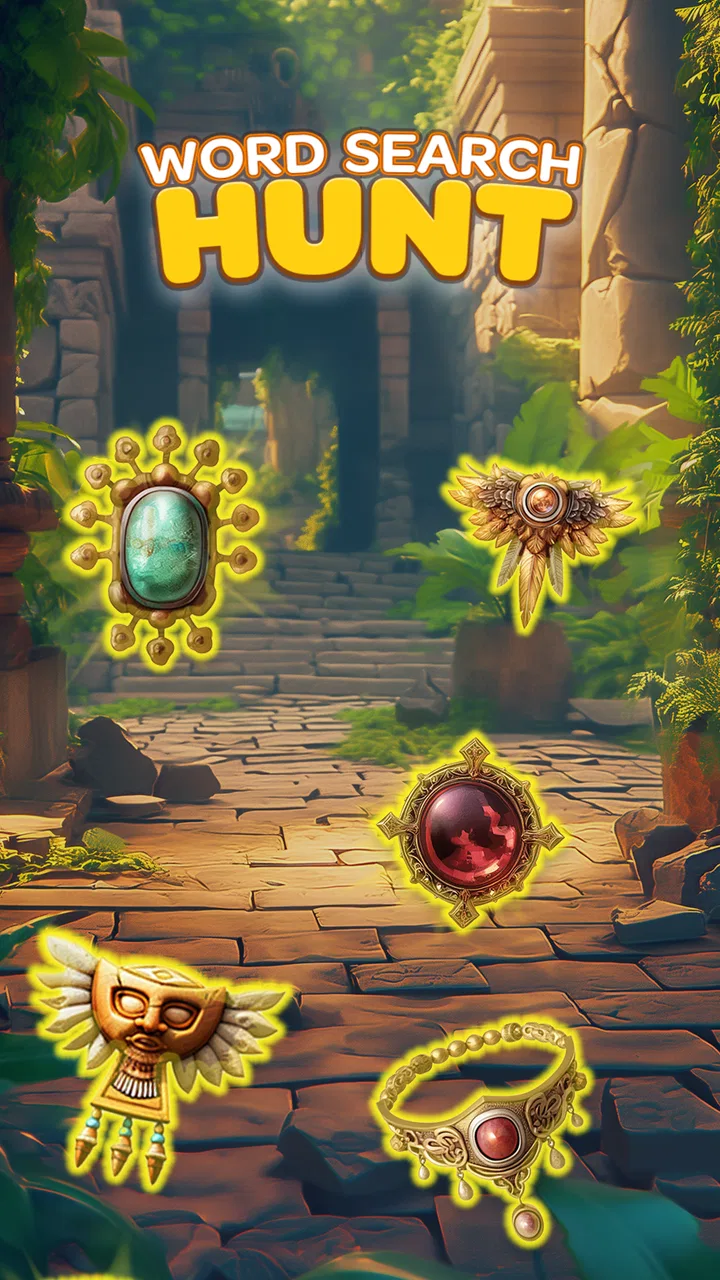
I opened Word Search Hunt expecting a familiar word-search pastime, but its presentation gives the basic format a more purposeful sense of place. Instead of feeling like a bare grid made only to fill a few minutes, it frames each puzzle as part of a hunt for relics. That small change matters: I found myself paying more attention to the setting and the feeling of progress, not just scanning letters.
This is a free word game from Mad Brain Games LTD, available for everyone and listed for devices running Android 10 or later. It has already attracted over 500 thousand installs and holds a 4.9 average from around 10 thousand ratings, which suggests that its straightforward idea has connected with a broad audience. I can understand why. The game is easy to approach, but its visual theme gives the familiar word-search formula a little more character than a plain puzzle book.
My first impression was that the game wants to be relaxing rather than competitive. The relic-hunting premise creates a gentle reason to continue, while the central activity remains simple enough to understand immediately. I did not need a tutorial-heavy explanation to know what to do. The important question is whether that calm presentation can keep the experience interesting after the novelty fades.
You May Also Like

 Blood Strike: 2.5 Anniversary
Blood Strike’s Loadouts Turn Every Drop Into a Tactical Gamble
A close look at Blood Strike’s custom loadouts: how fast access to signature weapons reshapes its battle royale rhythm, rewards preparation, and narrows the gap between fights.

 Pandora - Music & Podcasts
Pandora’s Music Is Easy to Start, but Harder to Recover
Pandora’s strength is its low-effort path from a seed to a station. Its weak spot is how much confidence it asks you to place in connection, setup, and quiet recovery.

 8 Ball Pool
 Is Built on Rivalries, Rematches, and Routine
A close look at the rivalries, rematches, shared routines, and unanswered safety questions that turn a quick pool match into a persistent mobile community.

 Samsung Music
’s Quiet Strength Is Playing What You Already Own
Its reach comes less from spectacle than from dependable access to a personal library. That simplicity is both the app’s strongest retention engine and its ceiling.

 AccuWeather: Weather Radar
AccuWeather Review: A Quick, Clear Forecast for Everyday Decisions
For everyday plans, the best forecast is the one you can understand quickly. AccuWeather makes rain timing, radar, and local conditions easy to act on, with a few trade-offs.

 Hill Climb Racing
Why Hill Climb Racing Still Turns Crashes Into One More Run
A tiny car, a bumpy hill and one more upgrade: Hill Climb Racing keeps resurfacing because its simple chaos makes every near-miss feel personal.
More From Our News Desk



How the hunt turns a simple grid into a setting
I find that a word-search game lives or falls on whether its atmosphere gives the familiar grid a reason to hold my attention. Here, the relic-hunt framing supplies that context, so this section looks at how the setting supports the puzzle without getting in its way. It also considers where the sense of place helps—and where it remains a light touch rather than a full adventure.
A visual theme that supports the puzzle
The strongest part of the presentation is the way the archaeological idea gives the word searches a recognizable identity. A standard puzzle grid can easily look interchangeable with dozens of other titles, but the relic language makes each solved board feel connected to a larger journey. I see the game less as a collection of isolated word lists and more as a sequence of small discoveries.
That approach works because it does not appear to overwhelm the core activity. The words still receive the attention they need, and the setting acts as a frame around them. For a puzzle game, that balance is important. If the artwork became too busy, it would make scanning the grid harder. If the theme were too weak, the hunt would feel like decoration pasted onto an ordinary word search.
I also like the contrast between the quiet concentration required by the grid and the more adventurous idea suggested by the relics. You are not controlling a character through a complicated map or managing a large inventory. Instead, exploration is translated into recognition: spot a word, mark it, and move the hunt forward. That is a smart fit for a game designed to be played in short, low-pressure sessions.
Why the setting matters more than it first appears
The setting gives the game a useful emotional hook for people who enjoy puzzles but do not necessarily want a story-heavy adventure. I can imagine playing it during a commute, while waiting for an appointment, or in the evening when I want something involving but not demanding. The relic concept adds a little curiosity without asking me to remember characters, plot details, or complicated objectives.
There is also a practical benefit to this kind of framing. When a puzzle is difficult, the surrounding hunt gives me a reason to stay with it instead of treating the board as a disposable challenge. I am still solving a word search, but the presentation makes completion feel like a small step in an ongoing activity. That is one of the non-obvious strengths here: the theme can help sustain attention even when the underlying action remains familiar.
On the other hand, players who want a rich adventure world may find the premise too light. The game uses the language of discovery, but it is still fundamentally a word-search title. I would not choose it expecting character development, strategic exploration, or a deep archaeological simulation. Its world exists to support the puzzles, not replace them.
Art direction and readability need to work together
For this type of game, attractive art is only useful when it leaves the letters clear. My standard is simple: can I scan a row, column, or diagonal without fighting the interface? Word Search Hunt benefits from keeping the puzzle itself at the center of the screen while the relic-hunting mood provides the context around it. That makes the visual identity feel functional rather than purely ornamental.
A useful habit is to resist rushing through the grid just because the theme feels relaxed. I found it more effective to scan in an organized pattern: first horizontal lines, then vertical ones, followed by diagonals and reversed words. This is especially helpful when a board includes several similar-looking letter combinations. The game’s calm atmosphere supports that method because it encourages careful observation rather than frantic tapping.
Sound, pacing, and the feel of each session
For me, a good session depends on a rhythm that leaves enough room to notice patterns without making every pause feel like lost time. I’ll look at how sound and pacing can shape that relaxed approach, along with a practical choice: whether to play in a quiet moment or use a puzzle as a brief reset between tasks. The distinction matters if you prefer a game that can be picked up and put down easily.
A quiet rhythm suits word searching
Word searches need a different rhythm from action games. The satisfying moments arrive in small steps: noticing a possible word, tracing it correctly, and watching the board become clearer. A loud or overly aggressive presentation would work against that rhythm. Word Search Hunt is better understood as a concentration game, where the mood should leave room for thought.
The relic theme reinforces that slower pace. It suggests looking carefully and uncovering something hidden, which is exactly what the player is doing with the letters. Even without complex mechanics, the game can create a coherent mood when the visual language and the act of searching point in the same direction. In my experience, that coherence is more valuable than adding unnecessary systems.
This also makes the game suitable for different kinds of breaks. If I have only a few minutes, I can focus on a single puzzle without needing to reconstruct a complicated situation. If I have longer, the hunt gives me a natural reason to continue. That flexibility is one of the clearest advantages over some alternatives that are built around fixed timers, lives, or rounds that punish interruption.
Where the pacing may lose some players
The same measured pace that makes the game comfortable can feel too gentle for anyone seeking urgency. Players who enjoy timed word challenges, head-to-head competition, or escalating pressure may find the experience less exciting than a faster word game. There is no reason to pretend that a calm relic hunt will satisfy every puzzle preference.
I would also be cautious about judging the game after only a few minutes. Its appeal is not based on a dramatic opening or a complicated first level. It is based on how naturally the presentation supports repeated searching. If you need immediate novelty, the familiar word-search structure may seem modest. If you enjoy settling into a pattern and improving your visual scanning, the slower design becomes an advantage.
For the best experience, I would play with notifications and other distractions out of reach, even if only for a short session. The game does not require intense concentration, but interruptions make it easier to lose track of which words I have already checked. A quiet environment also makes the setting and sound feel more coherent, rather than reducing the title to a sequence of taps.
Small sound details can shape the mood
Sound in a word game should reward progress without becoming repetitive. The ideal effect confirms that a word has been found, then gets out of the way so the next search can begin. That kind of restrained feedback matches the discovery theme better than constant noise would.
My advice is to treat audio as part of the atmosphere rather than the main attraction. If you enjoy a more immersive session, keep the sound on at a comfortable level. If you are playing in public or prefer to concentrate in silence, the game’s basic structure remains understandable without turning the audio into a requirement. That makes it more adaptable than games whose enjoyment depends heavily on music or spoken instructions.
Why the mechanics fit the mood
I’m interested in whether the game’s straightforward searching feels intentional or merely familiar. This section connects the act of spotting words with the mood of uncovering something, then considers how a deliberate scanning routine can make a grid feel less haphazard. That fit is also the key to deciding whether this kind of puzzle suits your habits better than a faster or more varied word game.
Simple rules, useful mental discipline
The central mechanic is immediately familiar: find hidden words in a letter grid. That simplicity is not a weakness by itself. It means the game can focus on observation, spelling, and pattern recognition instead of burying the player under instructions. I can hand it to someone who rarely plays games and expect them to understand the objective quickly.
The more interesting part is how the hunt framing changes the emotional meaning of that simple action. Finding a word is not presented only as checking off an item. It contributes to uncovering relics and moving through the game’s themed progression. The mechanic remains accessible, while the setting gives each successful search a little more context.
For younger players, the game’s Everyone rating makes it an approachable option for casual word practice. I would still treat it primarily as entertainment rather than a formal learning tool. It can encourage spelling awareness and visual focus, but a parent or teacher looking for structured vocabulary instruction would probably be better served by an educational app built specifically for that purpose.
Three practical ways to get more from the grids
My first useful technique is to search by word shape rather than reading every letter randomly. Look for unusual letters first, then check the directions around them. A rare starting letter can reduce the number of possible paths and make a difficult word easier to confirm. This is more efficient than dragging your eyes across the entire board repeatedly.
Second, when several words seem to overlap, solve the most distinctive one before the shortest one. Longer or less common combinations often reveal useful sections of the grid and reduce visual clutter. This creates a natural workflow: remove the obvious anchor, then use the cleared space to inspect the remaining candidates.
Third, if I become stuck, I stop searching for the whole word and instead compare its first and last letters. Word searches often become easier when I treat them as directional checks rather than as a general hunt. I look for a plausible endpoint, trace backward, and then verify the spelling. That method is especially useful during a tired evening session when random scanning becomes inefficient.
Progression is helpful, but the core remains familiar
The relic structure gives the game a reason to connect one puzzle to the next, but it does not transform the genre into a strategy game. There is no need to plan a build, manage resources, or learn a complex set of abilities. That is precisely why I would recommend it to someone who wants a dependable mental break rather than a game that demands long-term mastery.
The trade-off is replay identity. In a word search, the main pleasure comes from solving the current arrangement, not from developing a radically different play style. Players who need new mechanics every few minutes may eventually want something more varied, such as a word game with anagrams, crosswords, or timed challenges. Word Search Hunt is strongest when its consistency is what you want.
The current version is 0.37.1, and the game is free to start. Optional in-app purchases range from forty-nine cents to ninety-nine dollars and ninety-nine cents per item, so I would recommend checking the purchase flow carefully before handing the device to a child. The free entry point makes it easy to test the atmosphere and puzzle rhythm first, which is the sensible approach before considering any optional spending.
How it compares with ordinary alternatives
Compared with a plain word-search book or a basic utility-style puzzle app, this game offers more mood and a clearer sense of progression. A book may be better if you want no screen, no interface distractions, and complete control over your pace. A minimal puzzle app may be better if you care only about grids and want the fastest possible route into a challenge.
Compared with competitive word games, Word Search Hunt is less about speed and more about steady attention. That makes it a better choice for relaxing alone, but a weaker choice for players who want leaderboards, direct opponents, or high-pressure rounds. Compared with story-driven adventure games, it is much easier to pick up, but its narrative ambitions are correspondingly modest.
That distinction helps me place the game accurately. I would recommend it to someone who likes hidden-word puzzles and wants a themed wrapper that makes repeated sessions feel less plain. I would skip it in favor of a different option if my priority were deep storytelling, multiplayer rivalry, or a broad mix of word mechanics.
Who will enjoy the relic hunt most?
The best audience is people who enjoy quiet, repeatable puzzles and appreciate a little visual atmosphere around a familiar format. It is also a good fit for families looking for an accessible game with an Everyone content rating, provided adults keep an eye on optional purchases. The free starting price removes much of the risk: you can see whether the presentation and pacing suit you before spending anything.
I can also see it working well for adults who want a low-stress way to reset their attention. A short puzzle can act as a useful boundary between tasks, especially when I want something more active than passive scrolling but less demanding than a full game session. The relic theme gives that break a mild sense of purpose without adding pressure.
It is less suitable for people who dislike repetition in puzzle formats. If the basic act of scanning letters already feels tedious, the setting will not completely solve that problem. Likewise, players who prefer fast reactions, complex planning, or constant surprises should look elsewhere. The game’s appeal depends on enjoying the search itself.
One practical question is whether it works for occasional play. I think it does. The rules are easy to remember, and the short-session structure means I do not need to reserve a long uninterrupted period. Another question is whether it is appropriate for children. The Everyone rating makes it broadly accessible, but I would still explain that in-app purchases exist and use device-level purchase controls when needed.
For someone deciding whether to try it, I would suggest a simple test: play while deliberately following an organized scanning method rather than tapping randomly. If the combination of calm presentation, relic discovery, and gradual word finding feels satisfying, the game is probably a good match. If the grid itself does not hold your attention, no amount of thematic decoration will make it the right choice.
My atmosphere verdict
Word Search Hunt succeeds because its art direction and relic-hunting setting give a familiar mechanic a consistent emotional tone. The game does not need to pretend that word searching is an action adventure. Instead, it turns looking carefully into the central fantasy: uncovering something hidden one word at a time.
I especially appreciate the fit between the game’s pacing and its subject. The slow search, the sense of discovery, and the accessible rules support one another. That makes the experience easy to recommend for relaxed sessions, casual family play, and anyone who wants a word game with more personality than a blank grid.
Its limitations are equally clear. The core format remains traditional, the mood may be too quiet for competitive players, and the archaeological framing is not a substitute for a deep story. Those are not deal-breakers; they simply define what the game is trying to do. I would not install it expecting a complex adventure. I would install it expecting a polished-feeling, themed word-search break.
With a 4.9 average and over 500 thousand installs, it has clearly found an audience, and I think the reason is easy to understand once the first puzzle settles into its rhythm. Its real strength is the harmony between searching, discovery, and calm pacing. If that combination sounds appealing, the free version is worth trying, while players seeking competition or major mechanical variety should choose a different kind of word game.
FAQs for Word Search Hunt
01What is Word Search Hunt and how does it work?
Word Search Hunt is a puzzle game available for Android and iOS that challenges players to find hidden words within a grid of letters. The game offers various themed categories and levels of difficulty, allowing players to improve their vocabulary and cognitive skills while having fun. Players can swipe to select words and progress through increasingly challenging levels.
02Are there different difficulty levels in Word Search Hunt?
Yes, Word Search Hunt offers multiple difficulty levels to cater to both beginners and seasoned word search enthusiasts. You can start with easy grids to get accustomed to the gameplay, and gradually progress to more challenging puzzles. The game adjusts the complexity by changing grid sizes and the number of hidden words.
03Does Word Search Hunt require an internet connection to play?
No, Word Search Hunt can be played offline, making it a perfect game for long commutes or when you're away from Wi-Fi. However, you will need an internet connection to download the app initially and to access any updates or additional content that may be available online.
04Are there any in-app purchases in Word Search Hunt?
Yes, Word Search Hunt includes in-app purchases. While the game is free to download and play, it offers optional purchases such as hints, additional themes, and ad-free experiences. These purchases can enhance your gameplay, but they are not necessary to enjoy the full features of the game.
05How does Word Search Hunt support language learning?
Word Search Hunt supports language learning by offering word search puzzles in multiple languages. This feature allows players to expand their vocabulary in different languages while enjoying the game. It's a fun and interactive way to learn new words and improve language skills, making it useful for both native and foreign language learners.
Pros
- User-friendly interface for easy navigation.
- Variety of themes keep gameplay fresh.
- Offline mode available for on-the-go play.
- Daily challenges enhance engagement.
- Adaptive difficulty suits all skill levels.
Cons
- Ads can be intrusive during gameplay.
- Limited hints in free version.
- No multiplayer mode available.
- Occasional app crashes reported.
- In-app purchases can be pricey.

Word Search Hunt
Gallery